

I am typing this as I listen to Bach’s Brandenburg Concertos. I love all kinds of music but can only work whilst listening to jazz and baroque. Researchers have show that baroque music creates a mentally stimulating environment in which the brain can work. Apparently, it has a calming affect on brainwaves. J S Bach always lifts my mood and I love that fiction writer Douglas Adams in Dirk Golightly’s Holistic Detective Agency attributed Bach’s music to aliens who ‘helped’ the poet Coleridge to write Kubla Khan – a poem partly about inspiration and genius. Amongst the theories explored in Adams’s fiction is Jung’s collective unconsciousness. Jung says that mankind has a reservoir of experiences that anyone can dip into, which is why people come up with the same ideas simultaneously, yet independently. One example of this is the theory of evolution. Charles Darwin developed his idea of natural selection over 20 years but didn’t publish it until Alfred Russel Wallace wrote to Darwin with the same theory he had developed on his own.
Writers often talk about magically being ‘given’ whole stories to write. In such anecdotes there is no perspiration, only inspiration – sometimes genius or magic as described by Coleridge:
“His flashing eyes, his floating hair !
Weave a circle round him thrice,”
It is no surprise that people want to understand the process of creativity so that they can switch it on whenever they want to be brilliant in business and design.
Preparation, incubation, intimation, illumination and verification
In 1926 Graham Wallis proposed the above five stages to describe the process of creativity. Wallis claimed that first a person absorbs information and secondly the information settles. Thirdly, the person feels that a solution is coming and then, the solution manifests itself to the person so finally, it can be verified and a product is created.
Other theories have similar steps: analysis of the problem (preparation and incubation), idea generation (intimation and illumination), and evaluation (vertification). All embody the belief that creativity needs directed action and analysis. Getting creative does not mean waiting for a visit from the muse to be inspired.
Constraints
Constraints define the boundaries of the space within which we create solutions. Constraints can take the form of rules which artists obey. The haiku is an example of constraint-bound artwork. It has a strict form of 17 syllables which has three lines of five, seven, and five syllables.
We may feel that we must obey constraints, but by playing with them or ignoring certain constraints we can create different solutions. H G Wells dropped the constraint of time progressing linearly in his novel The Time Machine and explored the possibility of moving about in time in order to influences events in the past and future.
In business, we often hear about successful people ‘thinking outside the box’ to create innovative solutions.
Context
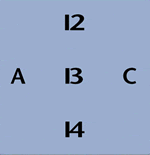
Getting creative in a void is difficult to do. Constraints may help us to delineate our problem but it is context that helps us to understand – the first step in creativity. Context impacts the way we interpret what we see. We can use this to explore new ideas.
Take an artefact and use it outside its original context. SMS texting was originally for engineers to communicate with each other. Who could have anticipated that a tool which made engineers’ lives easier would appeal to mobile phone users as a cheap and cheerful way of unobtrusive communication?
Analogy and metaphor
All humans have mental maps or models which help us to interpret the world around us – in a specific context or otherwise. If we don’t have a specific context our brain will provide us with one based on the models we have. We build these models over time using the experience we gain from interacting with the people and artefacts around us. Designers often try to engage these models, for example the desktop metaphor which is used in most PC platforms, to make user experiences more enjoyable.
We may take a textile pattern design and apply it to air traffic control to find better ways of supporting air traffic controllers. Looking at artefacts and finding new uses for them is sometimes known as interactive relabelling.
Fixation and exploitation
Fixing on a particular task objective such elegance or efficiency and dropping all other constraints such as money or utility is another way to get the creative juices flowing. Even if these new solutions are expensive or useless there may be something worthwhile in what they have to offer.
Using exploitation, the space of solutions is examined using a ‘what-if’ approach. Viewpoints and constraints are consistently changed to exploit the space, place it under pressure and watch it shatter into the fragment of a new solution. In bridge design this could mean placing excessive loads on the bridge to see how it responds.
Transformation, combination and exploration
There is nothing new under the sun. It is just as well that we take established ideas and combine them with other ones to create a fresh approach. By playing with context we surprise our users expectations and give them the unexpected.
We transform artefacts by performing tasks on them: we synthesise, analyse, and tweak what we know so that we can rearrange it into something we don’t.
The artificial intelligence community views the design space as something to explore, a mountain or a wilderness. A space may be incomplete or the domain knowledge is uncertain. This is reflected in the names of search techniques: hill climbing, branch-and-bound, hunter gatherer. They follow in the footsteps of all who have gone before, keen to add to the collective pool of knowledge and, no doubt, listening to Bach to inspire them to greatness.



4 comments